The Resolution Inference Rule
Substitutions
A substitution θ is a finite set of the form
{X1/t1,...,Xn/tn}
where each Xi is a distinct variable and each ti is a
term (or more generally, a member of some given set of objects) not containing
Xi.
Each element Xi/ti is called a binding for
Xi.
θ may be applied to an formula F to obtain Fθ,
the expression obtained from F by similtaneously replacing each occurrence of the
Xis in F by ti.
Similarly Sθ may be obtained from a set S of formulae.
A substitution can be applied to another substitution to form their composition.
Let θ = {X1/t1,...,Xn/tn}
and σ = {Y1/s1,...,Yn/sn}
The variables Xi must be distinct from the variables
Yi, and no Xi can appear in a si.
The composition θσ is formed by applying σ to the
ti, and combining the two sets.
For example, let
θ = {P1/jim,P2/brother_of(P4)}
and
σ = {P3/brother_of(P5),P4/geoff}.
Then
θσ =
{P1/jim,P2/brother_of(geoff),P3/brother_of(P5),P4/geoff}.
Unification
A substitution θ unifies a set S of expressions if
Sθ is a singleton.
A unifier θ is a most general unifier (mgu) for a set S if for each unifier
σ of S, there exists a sustitution γ such that
σ = θγ.
We are interested in substitutions that unify expressions.
| Example
|
|---|
U = { wise(X),
      wise(brother_of(Y)),
      wise(brother_of(Z)) }
is unified by θ = {X/brother_of(Z),Y/Z}.
|
The disagreement set of a set S of expressions is defined as follows :
Locate the left most symbol position at which not all expressions in S have the same
symbol and extract from each expression in S the subexpression beginning at that symbol
position.
The set of all such subexpressions is called the disagreement set.
| Example
|
|---|
U = { wise(X),
      wise(brother_of(Y)),
      wise(brother_of(Z)) }
has the disagreement set D = {X,brother_of(Y),brother_of(Z)}
|
Unification algorithm for a set U.
- Put k=0 and θ0={}
- If Uθk is a singleton then θk is a mgu
for U.
Otherwise find the disagreement set Dk of Uθk.
- If there exist variable V and term t in Dk such that
V does not occur in t, then set
θk+1 = θk{V/t}, increment k and loop.
Otherwise stop with failure.
| Example
|
|---|
U = { wise(X),
      wise(brother_of(Y)),
      wise(brother_of(Z)) }
| k
| θk
| Uθk
| Dk
|
| 0
| {}
| {wise(X),
wise(brother_of(Y)),
wise(brother_of(Z))}
| {X,
brother_of(Y),
brother_of(Z)}
|
| 1
|
{X/brother_of(Y)}
| {wise(brother_of(Y)),
wise(brother_of(Z))}
| {Y,
Z}
| | 2
|
{X/brother_of(Z),
Y/Z}
| {wise(brother_of(Z))}
|
|
|
| Examples
|
|---|
| U
| Result
|
{p(X,f(cat)),
p(f(Y),f(Y)),
p(f(Z),T)}
| {X/f(cat),Y/cat,T/f(cat),Z/cat}
|
{p(X,f(cat)),
p(f(Y),f(Y)),
p(f(dog),Z)}
| Failure
|
{p(f(Y),f(Y)),
p(f(Z),Z)}
| Occur check failure
|
|
The occur check is omitted in most Prolog implementations.
Resolution
Propositional binary resolution
| C| | L
| +
| D| | ~L
|
| |
»
| C| | D|
|
| Example
|
|---|
| i_am_clever | i_will_pass
| +
| ~i_am_clever | i_am_happy
|
C| = i_will_pass
L = i_am_clever
| |
D| = i_am_happy
~L = ~i_am_clever
|
| C| | D|
| =
| i_will_pass | i_am_happy
|
|
An intuitive view of binary resolution is as an implementation of modus ponens and modus tolens.
Full resolution generalizes the notion.
Propositional full resolution
| C| | L1 | ... | Ln
| +
| D| | ~L1 | ... | ~Lm
|
| |
»
| C| | D|
|
| Example
|
|---|
| i_am_clever | i_will_pass | i_am_clever
| +
| ~i_am_clever | i_am_happy
|
C| = i_will_pass
Li = i_am_clever
| |
D| = i_am_happy
~Li = ~i_am_clever
|
| C| | D|
| =
| i_will_pass | i_am_happy
|
|
Binary resolution
When performing resolution (and other inference steps) with formulae that contain variables, it
is necessary to rename variables such that no variables are common across the two clauses.
| C| | L
| +
| D| | ~M
|
|
| Lθ ≡ Mθ
|
| |
» |
(C| | D|)θ
|
The two parent clauses resolved against one another, upon the literals that unify.
The result is a resolvant.
If no literals remain after resolution, the resolvant is FALSE (indicating that the
parent clauses contradicted each other).
There may be multiple possible resolvant of a pair of parents, by selecting different
pairs of literals to resolve upon.
| Example
|
|---|
| ~wise(Z) | wise(brother_of(Z))
| +
| ~wise(X) | ~wise(brother_of(Y)) | taller(X,Y)
|
| 1st option
|
C| = ~wise(Z)
L = wise(brother_of(Z))
| |
D| = ~wise(brother_of(Y)) | taller(X,Y)
~M = ~wise(X)
|
| θ = {X/brother_of(Z)}
|
C|θ = ~wise(Z)
Lθ = wise(brother_of(Z))
| |
D|θ = ~wise(brother_of(Y)) | taller(brother_of(Z),Y)
Mθ = wise(brother_of(Z))
|
| (C| | D|)θ
| =
| ~wise(Z) | ~wise(brother_of(Y)) | taller(brother_of(Z),Y)
|
| 2nd option
|
C| = ~wise(Z)
L = wise(brother_of(Z))
| |
D| = ~wise(X) | taller(X,Y)
~M = ~wise(brother_of(Y))
|
| θ = {Y/Z}
|
D|θ = ~wise(X) | taller(X,Z)
Lθ = wise(brother_of(Z))
|
Mθ = wise(brother_of(Z))
C|θ = ~wise(Z)
| |
| (C| | D|)θ
| =
| ~wise(Z) | ~wise(X) | taller(X,Z)
|
|
Full resolution
| C| | L1 |...| Ln
| +
| D| | ~M1 |...| ~Mm
|
|
| Liθ ≡ Mjθ
|
|
| »
| (C| | D|)θ
|
There may be multiple possible resolvant of a pair of parents, by selecting different
combinations of literals to resolve upon.
| Example
|
|---|
| ~wise(Z) | wise(brother_of(Z))
| +
| ~wise(X) | ~wise(brother_of(Y)) | taller(X,Y)
|
| 1st option - See binary resolution 1st option
|
| 2nd option - See binary resolution 2nd option
|
| 3rd option
|
| C| = ~wise(Z)
| |
D| = taller(X,Y)
|
| L1 = wise(brother_of(Z))
| |
~M1 = ~wise(X)
~M2 = ~wise(brother_of(Y))
|
| θ = {X/brother_of(Z),Y/Z}
|
| C|θ = ~wise(Z)
| |
D|θ = taller(brother_of(Z),Z)
|
| L1θ = wise(brother_of(Z))
| |
M1θ = wise(brother_of(Z))
M2θ = wise(brother_of(Z))
|
| (C| | D|)θ
| =
| ~wise(Z) | taller(brother_of(Z),Z)
|
|
| Example
|
|---|
| wise(brother_of(geoff)) | wise(Z)
| +
| ~wise(X) | ~wise(brother_of(Y)) | taller(X,Y)
|
| 1st option
|
| L1 = wise(brother_of(geoff))
| |
~M1 = ~wise(X)
|
| θ = {X/brother_of(geoff)}
|
| |
» |
wise(Z) | ~wise(brother_of(Y)) | taller(brother_of(geoff),Y)
|
2nd option
| L1 = wise(brother_of(geoff))
| |
~M1 = ~wise(brother_of(Y))
|
| θ = {Y/geoff}
|
| |
» |
wise(Z) | ~wise(X) | taller(X,geoff)
|
| 3rd option
|
| L1 = wise(brother_of(geoff))
| |
~M1 = ~wise(X)
~M2 = ~wise(brother_of(Y))
|
| θ = {X/brother_of(geoff),Y/geoff}
|
| |
» |
wise(Z) | taller(brother_of(geoff),geoff)
|
4th option
| L1 = wise(Z)
| |
~M1 = ~wise(X)
|
| θ = {Z/X}
|
| |
» |
wise(brother_of(geoff)) | ~wise(brother_of(Y)) | taller(X,Y)
|
5th option
| L1 = wise(Z)
| |
~M1 = ~wise(brother_of(Y))
|
| θ = {Z/brother_of(Y)}
|
| |
» |
wise(brother_of(geoff)) | ~wise(X) | taller(X,Y)
|
| 6th option
|
| L1 = wise(Z)
| |
~M1 = ~wise(X)
~M2 = ~wise(brother_of(Y))
|
| θ = {Z/brother_of(Y),X/brother_of(Y)}
|
| |
» |
wise(brother_of(geoff)) | taller(brother_of(Y),Y)
|
| 7th option
|
L1 = wise(brother_of(geoff))
L2 = wise(Z)
| |
~M1 = ~wise(X)
| θ = {Z/brother_of(geoff),X/brother_of(geoff)}
|
| |
» |
~wise(brother_of(Y)) | taller(brother_of(geoff),Y)
|
| 8th option
|
L1 = wise(brother_of(geoff))
L2 = wise(Z)
| |
~M1 = ~wise(brother_of(Y))
| θ = {Z/brother_of(geoff),Y/geoff}
|
| |
» |
~wise(X) | taller(X,geoff)
|
| 9th option
|
L1 = wise(brother_of(geoff))
L2 = wise(Z)
| |
~M1 = ~wise(brother_of(Y))
~M2 = ~wise(brother_of(Y))
| θ = {Z/brother_of(geoff),X/brother_of(geoff),Y/geoff}
|
| |
» |
taller(brother_of(geoff),geoff)
| | | | | | |
|
Exercise
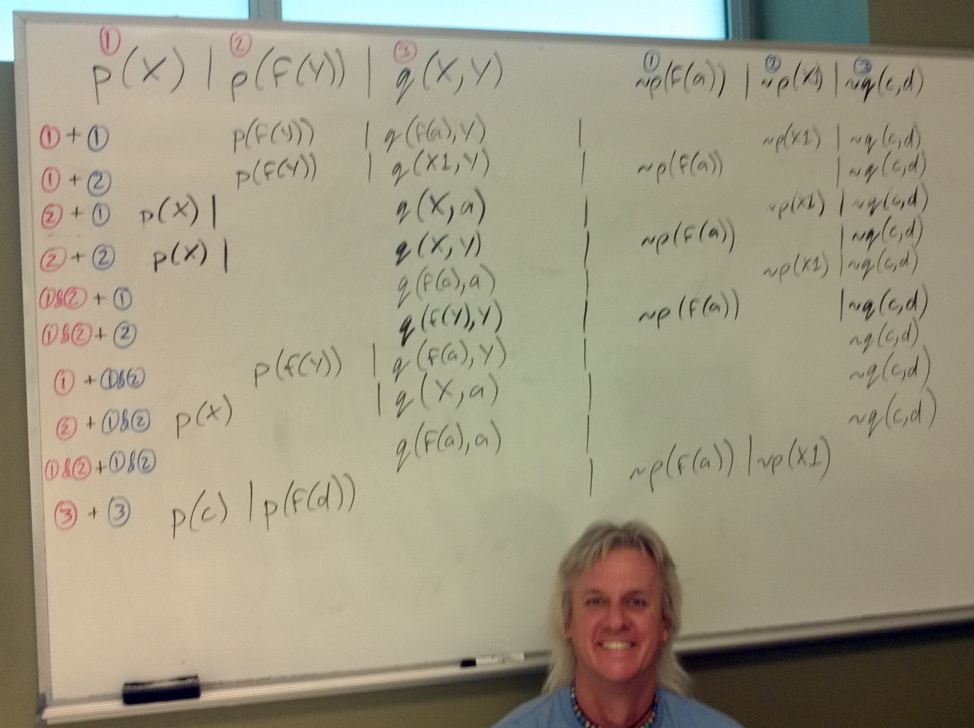
Find all possible resolvants of
p(X) | p(f(Y)) | ~q(X,Y)
and
~p(f(a)) | ~p(X) | q(c,d)
Answer
Resolution is a sound inference rule
If a set S of clauses is Herbrand satisfiable, then S ∪ {a resolvant from S} is also
Herbrand satisfiable.
| Proof
|
|---|
|
Let C| | L1 |...| Ln
and D| | ~M1 |...| ~Mk
be two clauses in a set of clauses S, satisfiable by the Herbrand model H, i.e., the two clauses
are TRUE in H.
Let Lis and Mjs be unifiable with most general unifier
θ, i.e., the clauses resolve to produce
(C| | D|)θ.
Let γ any Herbrand universe substitution so that
(C| | L1 |...| Ln)θγ and
(D| | ~M1 |...| ~Mk)θγ are ground.
- (C| | L1 |...| Ln)θγ
and
(D| | ~M1 |...| ~Mk)θγ
are TRUE in H.
- All Liθγ and Mjθγ are
ground and identical.
- (C| | D|)θγ is ground.
- If C|θγ is TRUE in H then
(C| | D|)θγ is TRUE in H.
- If C|θγ is FALSE in H then all
Liθγ is TRUE in H.
- If all Liθγ are TRUE in H then all
~Miθγ are FALSE in H.
- If all ~Miθγ are FALSE in H then
D|θγ must be TRUE in H.
- Hence (C| | D|)θσγ is TRUE in H.
As γ is arbitary, the resolvant (C| | D|)θ,
is TRUE in H, and S ∪ (C| | D|)θ is satisfiable.
|
| Example
|
|---|
|
Consider the resolution between the following two clauses, selected from a Herbrand satisfiable
set S.
Let H be a Herbrand model of S (e.g., the positive or negative interpretation).
| ~wise(Z) | wise(brother_of(Z))
| +
| ~wise(X) | ~wise(brother_of(Y)) | taller(X,Y)
|
| C| = ~wise(Z)
| |
D| = taller(X,Y)
|
| L1 = wise(brother_of(Z))
| |
~M1 = ~wise(X)
~M2 = ~wise(brother_of(Y))
|
| θ = {X/brother_of(Z),Y/Z}
|
| (C| | D|)θ
| =
| ~wise(Z) | taller(brother_of(Z),Z)
|
Let γ be {Z/jim}.
- (C| | L1)θγ = ~wise(jim) | wise(brother_of(jim))
and
(D| | ~M1 | ~M2)θγ =
~wise(brother_of(jim)) | ~wise(brother_of(jim)) | taller(brother_of(jim),jim)
are TRUE in H.
- Liθγ and Mjθγ =
wise(brother_of(jim))
- (C| | D|)θγ =
~wise(jim) | taller(brother_of(jim),jim) is ground.
- If C|θγ = ~wise(jim) is TRUE in H then
(C| | D|)θγ =
~wise(jim) | taller(brother_of(jim),jim) is TRUE in H.
- If C|θγ = ~wise(jim) is FALSE in H then
L1θγ = wise(brother_of(jim)) is TRUE in H.
- If L1θγ = wise(brother_of(jim)) is TRUE in H then
~Mjθγ = ~wise(brother_of(jim)) are FALSE in H.
- If ~Mjθγ = ~wise(brother_of(jim)) are FALSE in H then
D|θγ = taller(brother_of(jim),jim) must be TRUE in H.
- Hence (C| | D|)θγ =
~wise(jim) | taller(brother_of(jim),jim) is TRUE in H.
As γ is arbitary, the resolvant (C| | D|)θ =
~wise(jim) | taller(brother_of(Z),Z) is TRUE in H.
|
This theorem shows that all Herbrand models of S are Herbrand models of the resolvant.
In other words, resolvants are Herbrand logical consequences of the set.
If S ∪ {a resolvant from S} is Herbrand unsatisfiable then the S is Herbrand
unsatisfiable.
The Quest for Logical Consequence
To show that C is a logical consequence of Ax, it is necessary to:
- Show that every model of Ax is a model of C
OR
- Show that Ax ∪ {~C} is unsatisfiable.
Ax ∪ {~C} is unsatisfiable iff CNF(Ax ∪ {~C}) is unsatisfiable, so ...
- Show that CNF(Ax ∪ {~C}) is unsatisfiable.
A set of clauses has a model iff it has a Herbrand model, so ...
- Show that CNF(Ax ∪ {~C}) is Herbrand unsatisfiable.
An inference rule for clauses is sound if every Herbrand model of the parents is
a Herbrand model of the inferred clauses, and resolution is a sound inference rule for clauses,
so ...
Factoring
| Example (showing that binary resolution is not refutation complete)
|
|---|
S = { p(X) | q(Y) | q(X)
      ~q(a) | ~q(Z),
      ~p(a) }
| Full resolution
|
| p(X) | q(Y) | q(X)
| +
| ~q(a) | ~q(Z)
| » |
p(a)
|
| ~p(a)
| +
| p(a)
| » |
FALSE
|
| Binary resolution
|
| Try it, and fail
|
|
The Factoring Inference Rule
| C| | L1 |...|Ln
| +
| Factoring
|
|
| Liθ =
Ljθ
|
|
| »
| (C| | L1)θ
|
| Example
|
|---|
| ~wise(X) | ~wise(brother_of(Y)) |
taller(X,Y) | ~wise(brother_of(jim))
|
| 1st option
|
C| = ~wise(X) | taller(X,Y)
L1 = ~wise(brother_of(Y))
L2 = ~wise(brother_of(jim))
| +
| θ = {Y/jim}
|
| |
» |
~wise(X) | taller(X,jim) | ~wise(brother_of(jim))
|
| 2nd option
|
C| = ~wise(brother_of(Y)) | taller(X,Y)
L1 = ~wise(X)
L2 = ~wise(brother_of(jim))
| +
| θ = {X/brother_of(jim)}
|
| |
» |
~wise(brother_of(Y)) | taller(brother_of(jim),Y) | ~wise(brother_of(jim))
|
| 3rd option
|
C| = ~wise(brother_of(jim)) | taller(X,Y)
L1 = ~wise(X)
L2 = ~wise(brother_of(Y))
| +
| θ = {X/brother_of(Y)}
|
| |
» |
~wise(brother_of(jim)) | taller(brother_of(Y),Y) | ~wise(brother_of(Y))
|
| 4th option
|
C| = taller(X,Y)
L1 = ~wise(X)
L2 = ~wise(brother_of(Y))
L3 = ~wise(brother_of(jim))
| +
| θ = {X/brother_of(jim), Y/jim}
|
| |
» |
taller(brother_of(jim),jim) | ~wise(brother_of(jim))
|
|
Factoring is used in conjunction with binary resolution to produce full resolution.
| Example
|
|---|
| Full resolution
|
| ~wise(X) | ~wise(brother_of(Y)) | taller(X,Y)
| +
| ~wise(Z) | wise(brother_of(Z))
|
| |
» |
taller(brother_of(Y),Y) | ~wise(Y)
|
| Factoring and Binary resolution
|
| ~wise(X) | ~wise(brother_of(Y)) | taller(X,Y)
| +
| Factoring
|
| |
» |
~wise(brother_of(Y)) | taller(brother_of(Y),Y)
|
| ~wise(brother_of(Y)) | taller(brother_of(Y),Y)
| +
| ~wise(Z) | wise(brother_of(Z))
|
| |
» |
taller(brother_of(Y),Y) | ~wise(Y)
|
|
All full resolvants of two clauses are formed from all binary resolvants of the two clauses, and
all binary resolvants of all factors of the two clauses.
Some resolution strategies are complete using binary resolution and factoring, with the application
of factoring restricted to certain clauses.
This format produces a smaller search space than using full resolution (which in effect allows
factoring on all clauses).
Exam Style Questions
- What is the most general unifier of the following atoms:
p(X,f(Y),Z)
p(T,T,g(cat))
p(f(dog),S,g(W))
- What is the disagreement set of the following atoms:
p(X,f(Y),Z)
p(T,T,g(cat))
p(f(dog),S,g(W))
- List all the binary resolvants of the following two clauses:
p(X,f(Y),Z) | p(T,T,g(cat)) | r(X,T) | ~s(Z,T)
~p(f(dog),S,g(W) | s(big,rat) | ~s(small,hamster)
- List all the resolvants of the following two clauses:
p(X,f(Y),Z) | p(T,T,g(cat)) | r(X,T) | ~s(Z,T)
~p(f(dog),S,g(W) | s(big,rat) | ~s(small,hamster)
- List all the factors of the following clause:
p(X,f(Y),Z) | ~s(Z,T) | p(T,T,g(cat)) | p(f(dog),S,g(W)) | ~s(small,hamster)
- One resolvant of the clauses:
p(X,f(Y),Z) | p(T,T,g(cat)) | r(X,T) | ~s(Z,T)
~p(f(dog),S,g(W) | s(big,rat) | ~s(small,hamster)
is
r(f(dog),f(dog)) | ~s(g(cat),f(dog)) | s(big,rat) | ~s(small,hamster)
Show how that may be formed by factoring and binary resolution.
- Prove that if a set S of clauses is Herbrand satisfiable, then
S ∪ {a resolvant from S} is also Herbrand satisfiable
- Use resolution to derive the empty clause from the set
S = { ~p(X) | ~p(f(X)),
       p(f(X)) | p(X)
      ~p(X) | p(f(X)) }