- Recall the structure of an agent ...
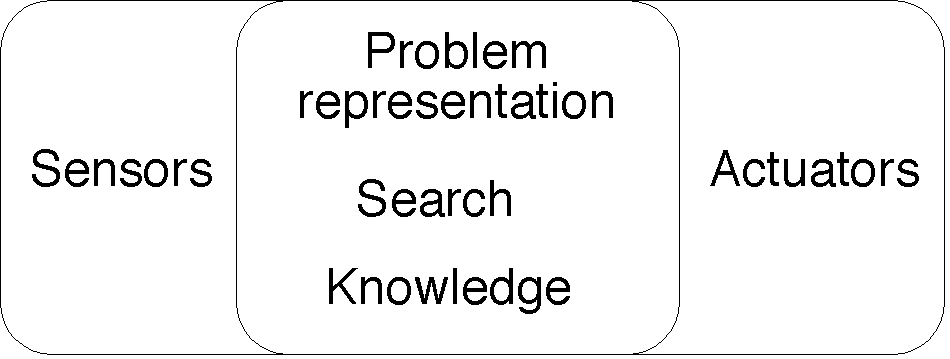
- A production system has 6 modules spread over the 3 parts of the central intelligence ...
- Problem representation
- Dynamic problem and environment information in states, in a growing space
of achieved states.
Includes the initial state.
- Other state lists and data structures as required.
- Ability to add new information to the knowledge base can change system behaviour.
- Knowledge base
- Static information (which forms part of every state, and thus need not be
duplicated).
- Optionally: Semantic information for the static and dynamic information
- Search control
- State transformation rules.
Can add new transformation rules that are consistent with old without disrupting
the system.
- A strategy, with access to the problem representation and knowledge base (the three
forms of information).
- A function that tests for a solution state
- The engine drives the system, and in conjunction with the control strategy and
transformations forms the solution generator of a classical problem description.
- In general terms, the production system algorithm ...
- Tests whether or not a solution state has been achieved
- It may be necessary to generate several goal states before halting as a "best"
solution might be required.
- Selects achieved state+transformation pairs, based on the three forms of information.
- Implements the selected transformations
- Inserts the new states in the achieved space of states.
- The achieved space of states has components:
- The dynamic space is all known states
- The frontier space is states from which transformations can still be done.
Sometimes separated from the dynamic space.
- The new space is states just discovered
- Must produce motion through the state space.
- Influence of environment characteristics
- Accessibility
- Greater accessibility gives a greater possible role to knowledge
- Dynamism
- Knowledge changes during process - may be out of date
- Semi-dynamic plays time off against performance.
- Continuity
- Agents
- Multi-agent means a dynamic environment and/or a strategic problem
- Influence of problem characteristics
- Determinism
- Deterministic: Can choose transformation by predicting new states.
Can plan ahead.
- Searchable: Can search ahead.
- Non-deterministic:
Cannot predict new states.
Cannot plan or search ahead.
Requires repeated sensing.
- Decomposability
- If episodic, each episode can be treated separately.
No relative state information between episodes.
- Recoverability
- Recoverable: Can do any number of transformations from any number of states.
No need to plan ahead - good for non-deterministic problems.
- Backtrackable: Must do one transformation from "current" state, but can always
transform back. Needs a loop check for sure.
- Non-recoverable: Must do one transformation from the current state.
- Solution quality
- Best solution possible if recoverable or backtrackable
- Selecting applicable transformations
- Matching
- Involves search through the pre-conditions and finding all that match.
- Slow if there are a lot of rules.
- Indexing
- Use the current state as an index into the rules to find appropriate rules.
- Could use a partial index then search - the usual hashing techniques.
- Matching with variables (unification)
- Must keep bindings and apply them to the post-condition of the rule to get the new
state.
- More variables means more general rules but more matches with the problem state.
- Approximate matching.
- Arises from imprecise states and imprecise rules.
- Production system engine algorithm, for
- Problem: deterministic, non-decomposable, recoverable, any solution problem
- Environment: none
- Choose state, expand all ways
Suitable for, e.g., a theorem prover
Problem = SenseProblem();
KB = StaticPartOf(Problem);
CurrentState = DynamicPartOf(Problem);
NewStates = {CurrentState};
DynamicStateSpace = {};
FrontierStates = {};
while (! SolutionFound(NewStates)) {
    FrontierStates += NewStates;
    StateToTransform = ExtractStateToTransform(FrontierStates,KB,DynamicStateSpace);
    DynamicStateSpace += StateToTransform;
    NewStates = ApplyAllTransformations(StateToTransform);
}
- To extend that to a best solution (e.g., a journey planner in
a perfect world), call ...
SolutionFound(NewStates,FrontierStates)
and install ...
SolutionFound(NewStates,FrontierStates) {

    static BestSolutionSoFar = NULL;

    foreach (State in NewStates) {
        if (IsSolution(State) && State > BestSolutionSoFar) {
            BestSolutionSoFar = State;
        }
    }
    foreach (State in NewStates + FrontierStates) {
        if (State could get better than BestSolutionSoFar) {
            return(FALSE);
        }
    }
    return(TRUE);
}
- Production system engine algorithm, for
- Problem: deterministic, non-decomposable, backtrackable, any solution problem
- Environment: none
- Can expand only one way
Suitable for, e.g., simple maze solving.
Problem = SenseProblem();
KB = StaticPartOf(Problem);
CurrentState = DynamicPartOf(Problem);
DynamicStateSpace = {};
while (! SolutionFound(CurrentState)) {
    Transformation = ChooseTransformationFromCurrentState(CurrentState,KB,DynamicStateSpace);
    if (Transformation == "backtrack") {
        CurrentState = PreviousState(CurrentState,DynamicStateSpace);
    } else {
        DynamicStateSpace += (CurrentState,Transformation);
        CurrentState = ApplyTransformation(CurrentState,Transformation);
    }
}
- Production system engine algorithm, for
- Problem: deterministic, non-decomposable, recoverable, any solution problem
- Environment: accessible, dynamic, discrete, single agent
- Choose state, expand one way
Suitable for, e.g., web spider
Problem = SenseProblem();
KB = StaticPartOf(Problem)
CurrentState = DynamicPartOf(Problem);
DynamicStateSpace = {};
while (! SolutionFound(CurrentState)) {
    Environment = SenseEnvironment();
    (FromState,Transformation) = ChooseStateAndTransformation(Environment,KB,DynamicStateSpace);
    DynamicStateSpace += (CurrentState,Transformation);
    CurrentState = ApplyTransformation(FromState,Transformation);
}
- Production system engine algorithm, for
- Problem: non-deterministic, non-decomposable, non-recoverable, any solution
- Environment: accessible, dynamic, continuous, single agent
- Can expand only one way
Suitable for, e.g., boat navigation
Problem = SenseProblem();
KB = StaticPartOf(Problem)
CurrentState = DynamicPartOf(Problem);
DynamicStateSpace = {};
while (! SolutionFound(CurrentState)) {
    Environment = SenseEnvironment();
    Transformation = ChooseTransformationFromCurrentState(CurrentState,KB,DynamicStateSpace,Environment);
    ApplyTransformation(CurrentState,Transformation);
    DynamicStateSpace += (CurrentState,Transformation);
    CurrentState = DynamicPartOf(SenseProblem());
}